
Does Your Car Have Factory Rev-Match? Here’s What Drivers Are Doing If It Doesn’t
Automatic rev-matching has gone from a novelty to a near-universal feature on performance cars in the space of about fifteen years. If you’re driving something built in the last few years, there’s a good chance it’s already there. If you’re driving a C5 Corvette, a Porsche 996 or 997, a pre-2019 Mustang GT, a Nissan 350Z, or a first-generation BRZ, it isn’t — and a large and vocal community of drivers in exactly those cars has spent years working out what to do about it.
How Factory Rev-Match Became the Standard
Nissan introduced the first production automatic rev-matching system in 2009 with the 370Z, calling it SynchroRev Match. The concept was straightforward: the car’s computer monitors clutch and brake input, identifies a downshift in progress, and blips the throttle automatically to match engine speed to the lower gear before the clutch re-engages. The result was the smooth, settled downshift that previously required years of practice to execute consistently.
The industry noticed. Within a decade, factory rev-matching spread across the performance car segment. The Chevrolet Corvette C7 and C8, Porsche 911 and 718, Toyota GR86, Subaru BRZ (second generation), Honda Civic Type R, Acura Integra, and BMW M2 and M3 all include the feature as standard or optional equipment. CarBuzz noted in 2025 that almost every manual-equipped performance car on sale now features automatic rev-matching, with a handful of notable exceptions.
Those exceptions are important. They include some of the most popular enthusiast platforms on the road — cars that were built before the technology was standard and are now sitting in garages and on tracks without the feature their newer counterparts ship with from the factory.
The Cars That Missed the Cut
The Corvette C5 (1997–2004) and C6 (2005–2013) are two of the most tracked American cars ever made, with a dedicated owner base that has been running them at club events for decades. Neither generation included factory rev-matching. CorvetteForum has multiple long-running threads on the subject, with drivers asking whether the feature can be retrofitted via software or hardware — a question that has consistently gone unanswered by GM.
The Porsche 996 (1999–2004) and 997 (2005–2012) are in the same position. Both generations are deeply embedded in the track day community — accessible enough to buy used, capable enough to be competitive, and missing the rev-match technology that appeared in the 991 and later cars. Rennlist threads document experienced 996 and 997 drivers discovering the feature for the first time in a newer car and returning to their own with a different perspective on what they’ve been managing manually.
The Ford Mustang GT and Shelby GT350 received Active Rev Matching on the 2019 model year refresh. Every S550 Mustang built before that — the 2015 through 2018 models — shipped without it. Mustang6G has an entire thread dedicated to retrofitting the factory feature to earlier cars, running to multiple pages, with no viable solution found. The conclusion that emerged: the rev-match on the 2019 is software-based and tied to hardware changes that can’t be cleanly backported.
The Nissan 350Z, which predates the 370Z by a generation, has no factory rev-matching. Neither does the first-generation Subaru BRZ and Toyota 86 (2012–2021), which received the feature only with the second-generation redesign in 2022. These are cars that attract exactly the kind of engaged, modification-oriented driver who would benefit most from the technology.
What the Forums Settled On
Across CorvetteForum, Mustang6G, Rennlist, and the Nissan and BRZ communities, the conversation about retrofitting factory rev-match follows a consistent arc. Drivers ask whether it can be done through a tune or software update. The answer is almost always no — factory rev-match on modern cars is integrated at a level that doesn’t translate to earlier hardware. The thread then pivots to aftermarket options, and AUTO-BLiP is consistently the solution that surfaces.
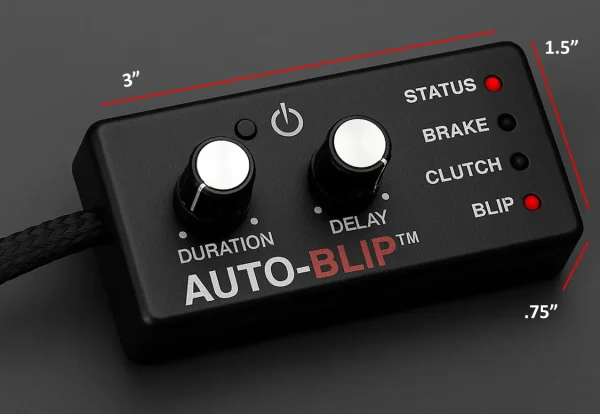
The appeal is direct. AUTO-BLiP wires into the vehicle’s existing throttle, brake, and clutch sensors — the same inputs a factory system would use — and executes the throttle blip electronically on every qualifying downshift. It does not touch the ECU, does not generate fault codes, and does not alter any other vehicle system. Two dials on the unit allow the timing and blip intensity to be calibrated to the specific car, adjustable between sessions. A bypass switch allows it to be disabled instantly.
On Mustang6G, users who installed AUTO-BLiP on pre-2019 GT and GT350 cars described it as delivering exactly what the 2019 Mach 1’s factory system provides — consistent, smooth rev-matched downshifts on every shift, without the mental overhead of heel-toe execution. One member who drove a friend’s Mach 1 at a track event specifically cited the factory rev-match as a revelation, then installed AUTO-BLiP on their own car the following week.
It Handles the Downshift. Everything Else Is Still You.
One of the most common objections to any rev-match aid is that it takes something away from the driving experience. The reality with AUTO-BLiP is the opposite. The unit only activates on downshifts — specifically when the brake and clutch are pressed together in sequence. Upshifts are entirely unaffected. Gear selection, clutch modulation, throttle application, steering, and every other aspect of driving the car remain fully in the driver’s hands.
What AUTO-BLiP removes is the single most physically demanding coordination task in manual driving: executing a precise throttle blip with one foot while maintaining full brake pressure with the same foot, under load, at the moment the car is most dynamically sensitive. Everything that makes a manual feel like a manual — the engagement, the involvement, the direct mechanical connection — stays intact. The technique that requires years to master under ideal conditions, and degrades under fatigue and pressure, is the only thing replaced.
For drivers who have spent time in cars with factory rev-matching, this distinction is familiar. The GR86, the 992, the C8 Corvette — none of them feel automatic. They feel like manuals that have one less failure point on corner entry.
What About Cars That Already Have Factory Rev-Match?
AUTO-BLiP is not limited to cars that lack factory rev-matching. Drivers in vehicles like the 2018 Porsche Cayman — which includes Porsche’s factory Sport Chrono auto-blip tied to drive mode selection — have found value in running AUTO-BLiP alongside it. The reason is control. Factory systems are calibrated to a fixed behavior and tied to drive mode settings that may not suit every driver or every situation. AUTO-BLiP’s two adjustment dials allow the blip timing and intensity to be tuned specifically to the driver’s preference and adjusted between sessions without tools or software. Drivers who want a stronger or softer blip than the factory system delivers, or who want rev-matching available independently of their drive mode selection, use AUTO-BLiP to get exactly that.
The 718 forum community has documented this directly — Cayman and Boxster owners running AUTO-BLiP not as a replacement for the factory system but as a complement to it, with finer on-the-fly control than the OEM calibration allows.
The Search That Leads Here
The drivers searching for rev-match retrofits are not casual browsers. They have already identified what they want, understood why factory systems work the way they do, and determined that a software solution isn’t available for their car. They are one step from a purchase decision. The search terms they use — “rev match C5 Corvette,” “auto blip 997,” “rev matching retrofit Mustang GT,” “BRZ downshift module” — are among the highest-intent queries in the manual transmission aftermarket.
AUTO-BLiP has been the answer to those searches for drivers in those communities for over a decade. The Standard unit covers the majority of manual cars with electronic throttle systems. The Corvette C5-specific unit addresses that car’s unique sensor configuration directly. The Plus unit covers vehicles with active accelerator pedal systems, including the second-generation GR86 and BRZ.
If your car doesn’t have factory rev-matching, it’s not because the technology doesn’t exist for it. It’s because your car was built before the industry standardized it. And if it does — AUTO-BLiP gives you more of it, on your terms.