
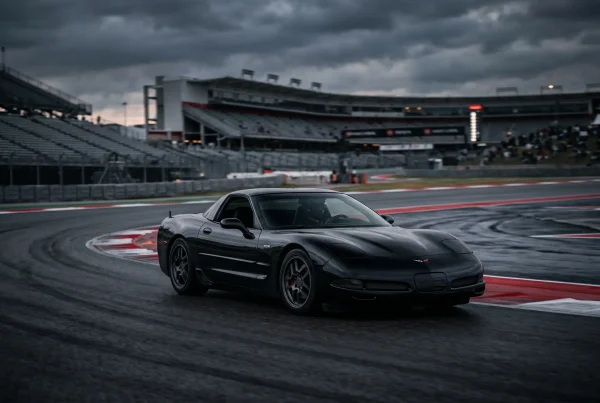
What Rev-Matching Actually Does to Your Car
Most manual transmission drivers know that rev-matching is the “correct” way to downshift. Fewer understand exactly what it protects, why skipping it adds up over time, and what that means for a car that occasionally sees a mountain road or a fast off-ramp. This article is for the everyday driver who loves their manual — and wants to keep it in good condition.
What Actually Happens on a Mismatched Downshift
When the clutch re-engages after a downshift, the engine and transmission need to be spinning at compatible speeds. If they aren’t — because no throttle blip happened — the clutch disc absorbs the difference as friction and heat, and the transmission synchros work overtime to equalize what’s left. Neither is designed to take that hit on every single downshift. Rev-matching closes that gap before the clutch comes up, so both components reconnect with minimal stress. It’s a small thing per shift. Across the life of a car, it isn’t.
What Wears When You Skip It
The clutch disc and transmission synchros are both friction components with a finite service life. Consistent unmatched downshifts accelerate wear on both — quietly, incrementally, in ways that don’t show up until a repair bill does. PistonHeads forum members who rev-matched for decades report never replacing a clutch past 150,000 miles. The ones who didn’t tend to tell a different story. Second and third gear synchros take the most punishment since those are the gears most often involved in downshifts from any real speed.
The Spirited Drive Scenario
The mechanical case for rev-matching is easy to make on a track, where the shift count is high and every downshift happens under load. It applies equally on the kind of drive that most manual enthusiasts know well: a twisty road, a mountain pass, an engaging stretch of highway off-ramp. The shifts are fewer, but the conditions are similar — braking while downshifting, gear changes under deceleration, occasional back-to-back corners that require multiple steps down through the gears.
In those situations, an unmatched downshift does not just create wear. It also creates a brief destabilization of the car. The driveline lurch that follows a poorly matched downshift transfers weight forward at exactly the moment weight is already shifting from braking. Most drivers learn to manage this without consciously identifying it. The car feels slightly choppy, slightly unsettled on entry. With consistent rev-matching, that sensation disappears — the car stays composed through the entire braking and downshift sequence.
A Rennlist member with four decades of experience put it simply: if you are not blipping on downshifts, you are trading clutch life for brake life. The engine braking that makes a manual feel engaging also places the drivetrain under load — and without rev-matching, that load passes through the clutch and synchros as wear.
Why Most Drivers Don’t Rev-Match Consistently
The honest answer is that heel-toe — the traditional technique for rev-matching while braking — is difficult to execute reliably in a street car. Pedal geometry varies widely between manufacturers and models. The technique requires simultaneous control of brake pressure, throttle blip, and clutch timing, all coordinated with one foot. Even drivers who have practiced it for years find that the quality of their execution degrades when they’re focused on other things — traffic, unfamiliar roads, or simply driving with more attention on the environment than the footwell.
The result is that many manual drivers rev-match some of the time, inconsistently, and skip it the rest. The car’s synchros and clutch disc absorb the difference quietly, incrementally, in ways that don’t announce themselves until service is due.
What AUTO-BLiP Does for the Everyday Driver
AUTO-BLiP is an advance electronic module that wires into the vehicle’s throttle, brake, and clutch sensors. When it detects a downshift in progress — brake and clutch pressed together — it executes a precisely calibrated throttle blip automatically. The result is a rev-matched downshift every time, without any additional input from the driver.
For the driver who uses their manual occasionally for spirited driving but isn’t trying to master heel-toe technique, this means the drivetrain protection that rev-matching provides is present on every relevant downshift. The clutch disc and synchros see consistent, low-stress re-engagements rather than absorbing the mismatch that comes from an unmatched drop into a lower gear.
Drivers in the Corvette, Mustang, and Porsche communities who have run AUTO-BLiP describe the same consistent benefit: downshifts that feel smooth and settled, a car that stays composed on corner entry, and the confidence that comes from knowing the drivetrain is being treated well. One CorvetteForum member noted that the convenience freed up mental focus for corner entry — which is precisely where attention belongs.
The unit does not activate during normal upshifts or stop-and-go driving. It is only triggered when brake and clutch are pressed together in a downshift sequence, which means it operates exactly when rev-matching matters and stays out of the way the rest of the time. A bypass switch on the faceplate allows it to be turned off whenever the driver prefers.
The Simple Case for Protecting What You’ve Got
A manual transmission car is a mechanical investment. The clutch, the synchros, and the driveline components that make it feel the way it does are wear items — and how quickly they wear is directly influenced by how the car is driven. Rev-matching on downshifts is one of the most straightforward things a driver can do to extend the service life of those components. It does not require track days or performance driving. It applies every time the car is driven with any engagement at all.
AUTO-BLiP makes consistent rev-matching accessible to any driver in any compatible manual car. The protection is there on the mountain road, on the spirited run, and on the commute home when the driver’s attention is elsewhere. The drivetrain absorbs smooth, matched re-engagements rather than the accumulated stress of thousands of unmatched ones.
That is what rev-matching actually does to your car — and why doing it consistently is worth more than most drivers realize.